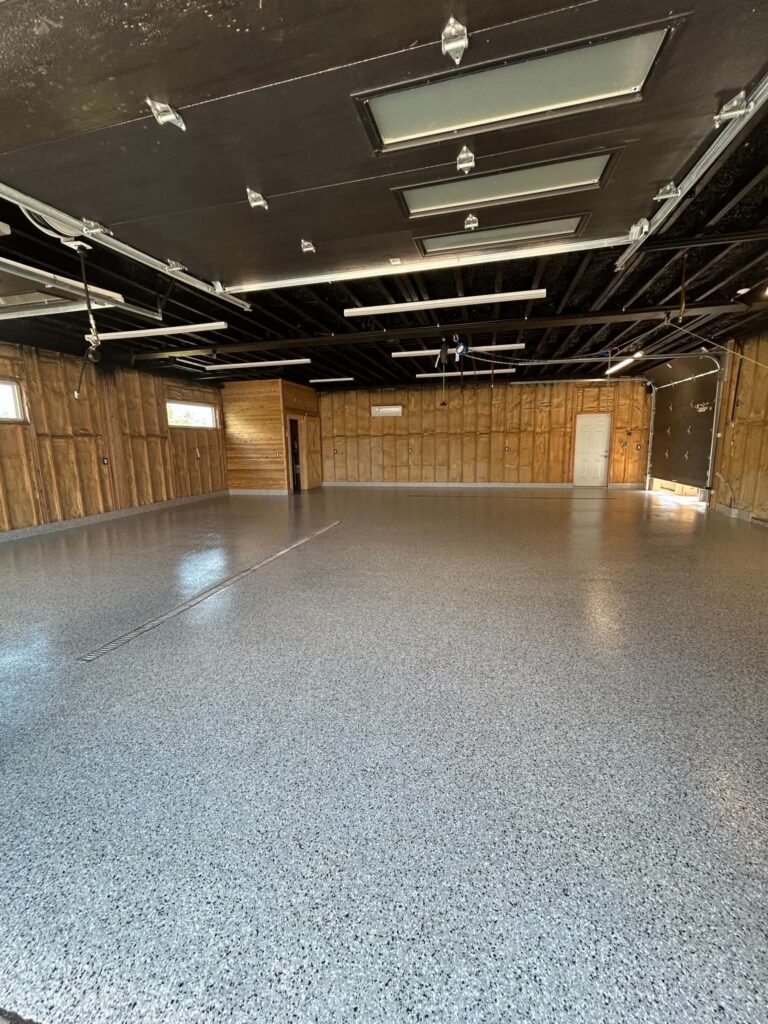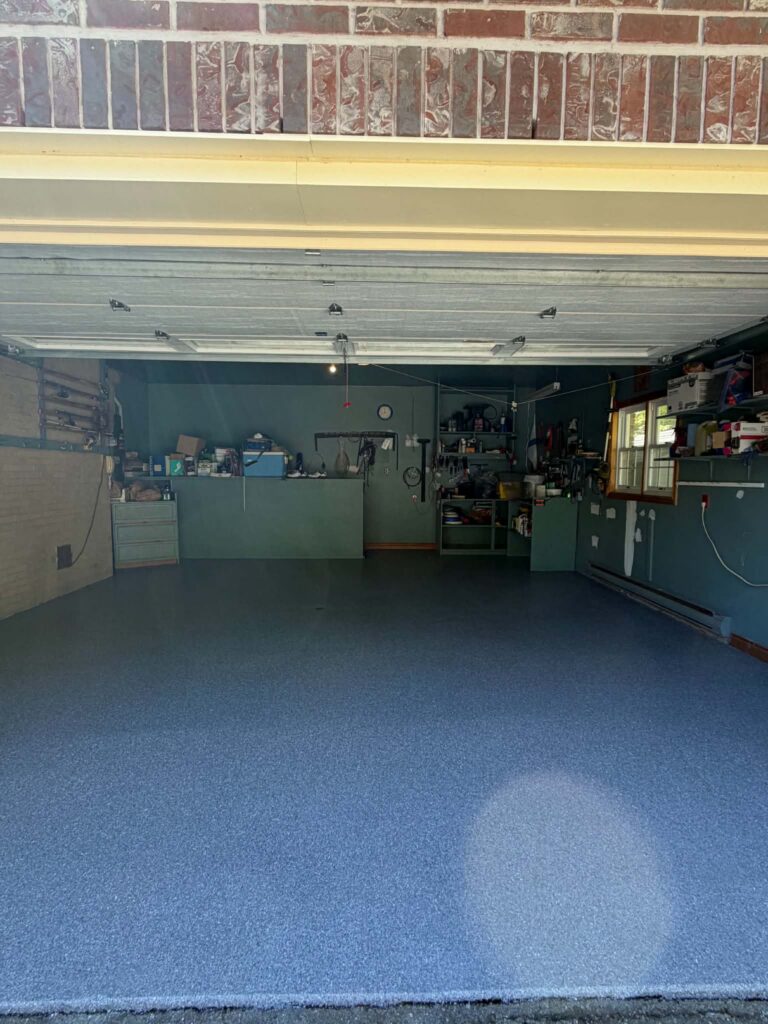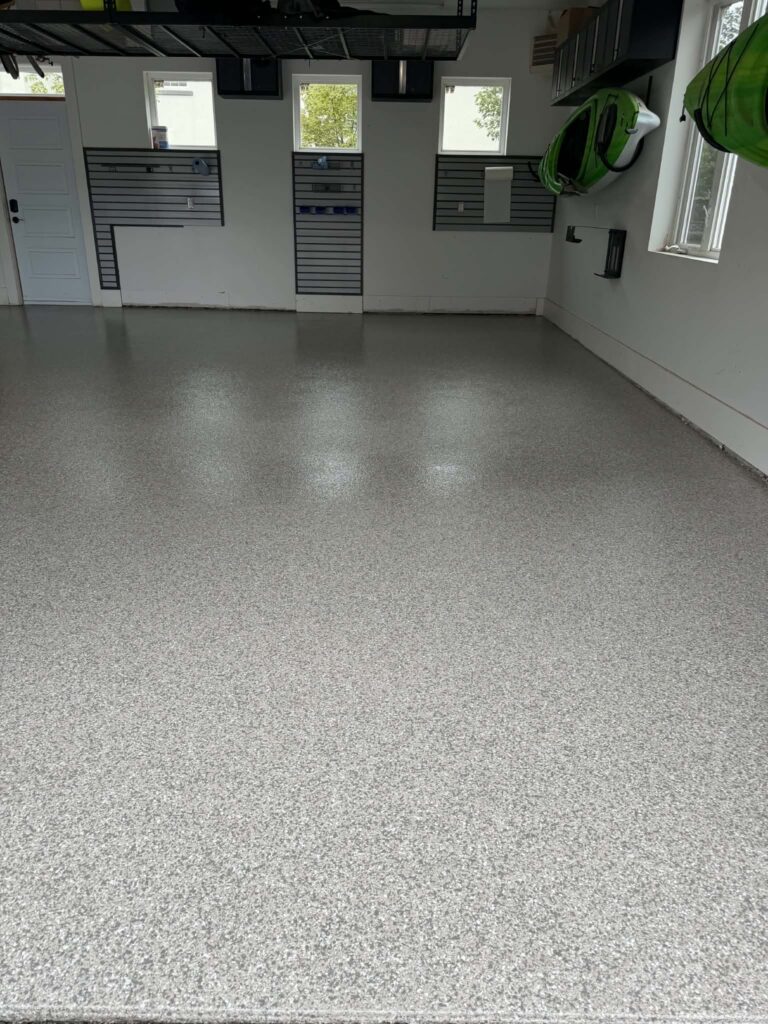
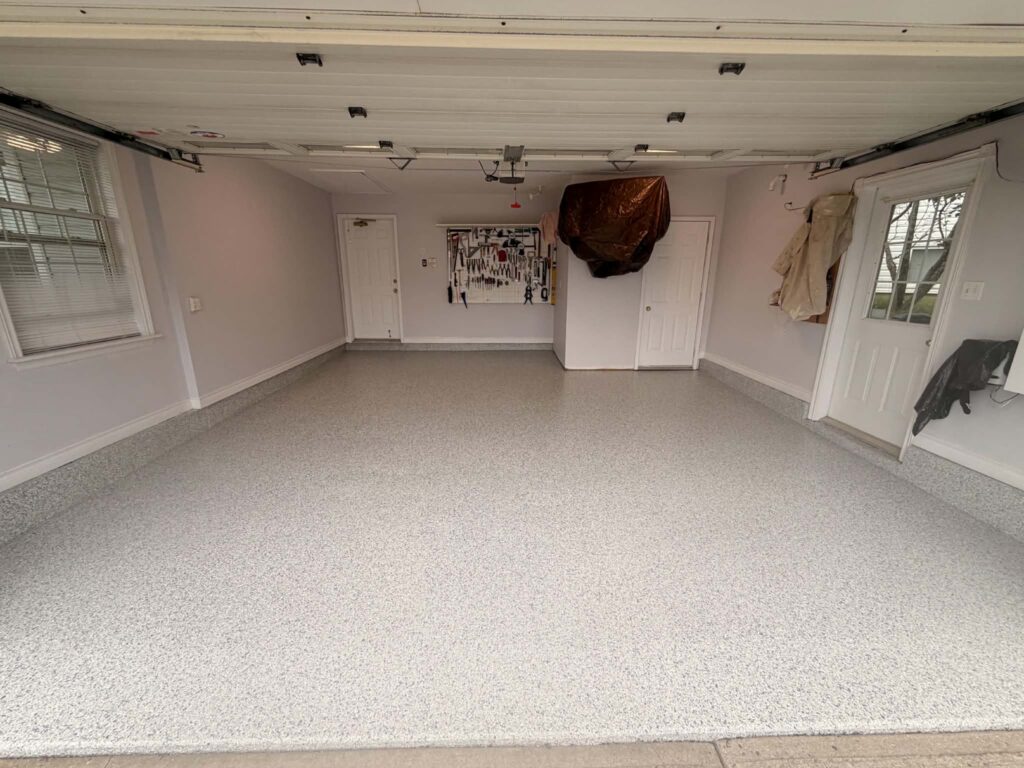
Most people booking a garage floor coating have the same two questions, and neither of them is about chemistry. They are: how long will my garage be out of action, and what do I have to do? This 400 sq ft garage in Dartmouth, NS is a good answer to both. Polyurea system, Tidal Wave flake, finished in a single day. Here is exactly how that day goes.
Project snapshot: 400 sq ft garage floor, Dartmouth NS
| Detail | Spec |
|---|---|
| Location | Dartmouth, Nova Scotia |
| Area | 400 sq ft (standard two-car garage) |
| System | Polyurea coating system with full flake broadcast and clear topcoat |
| Flake colour | Tidal Wave — clean whites, river greys and soft blue tones |
| Prep | Diamond grinding with dust extraction, crack and joint treatment |
| Install time | 1 day |
| Back in use | Foot traffic the same evening, vehicles within 24 hours |
| Warranty | 20 years |
What a one-day garage floor coating actually looks like
On a 400 sq ft garage in good condition, the whole job fits inside a working day. Roughly:
Morning: grinding
We mask off, then diamond grind the entire slab with dust extraction running at the tool. This is the part that decides everything. Grinding strips old sealer, paint and the weak surface layer, and opens a mechanical profile the polyurea can bite into. It is also the noisiest part of the day, and it is over by lunchtime.
Late morning: repairs and detailing
Cracks, joints, pitting and any spalled edges get cut, cleaned and filled, then ground flush. Edges, the wall base and the door threshold are cut in by hand.
Early afternoon: base coat and flake
The pigmented polyurea base goes down wet, working back to front, and the Tidal Wave flake is broadcast into it until the surface refuses to take any more. Broadcasting to refusal is what gives a flake floor its consistency — a light broadcast leaves thin, patchy areas that show under garage lighting.
Mid-afternoon: scrape, vacuum, topcoat
Once the base has set, the loose flake is scraped back and vacuumed, leaving a uniform profile. The clear topcoat then seals the whole system and gives the floor its finish.
Evening: you walk on it
Foot traffic the same evening, vehicles back in within 24 hours. That is the practical reason we build on polyurea rather than epoxy — epoxy would want several days between coats and would struggle to cure at all in a cool Nova Scotia garage. The full comparison is in epoxy vs polyaspartic explained.
What you need to do before we arrive
Not much, but the one thing matters:
- Empty the garage. Everything off the floor and away from the walls — shelving, bikes, tires, the freezer, the lot. We grind wall-to-wall, so anything left behind becomes an uncoated patch.
- Park elsewhere for the day and overnight. One day out, plus the overnight cure.
- Leave the rest to us. Masking, dust control, cleanup.
We wrote a full checklist: how to prepare your garage for a floor coating installation.
Why 400 sq ft is the size we do most often
A standard two-car garage in HRM lands right around 400 sq ft, and it is comfortably a single-day job. Worth knowing: the system we install here is the same system we put in a 1,700 sq ft shop — same polyurea, same broadcast-to-refusal method, same 20-year warranty. The difference is crew size and logistics, not quality. If you have a larger space, see our 1,700 sq ft garage floor in Antigonish.
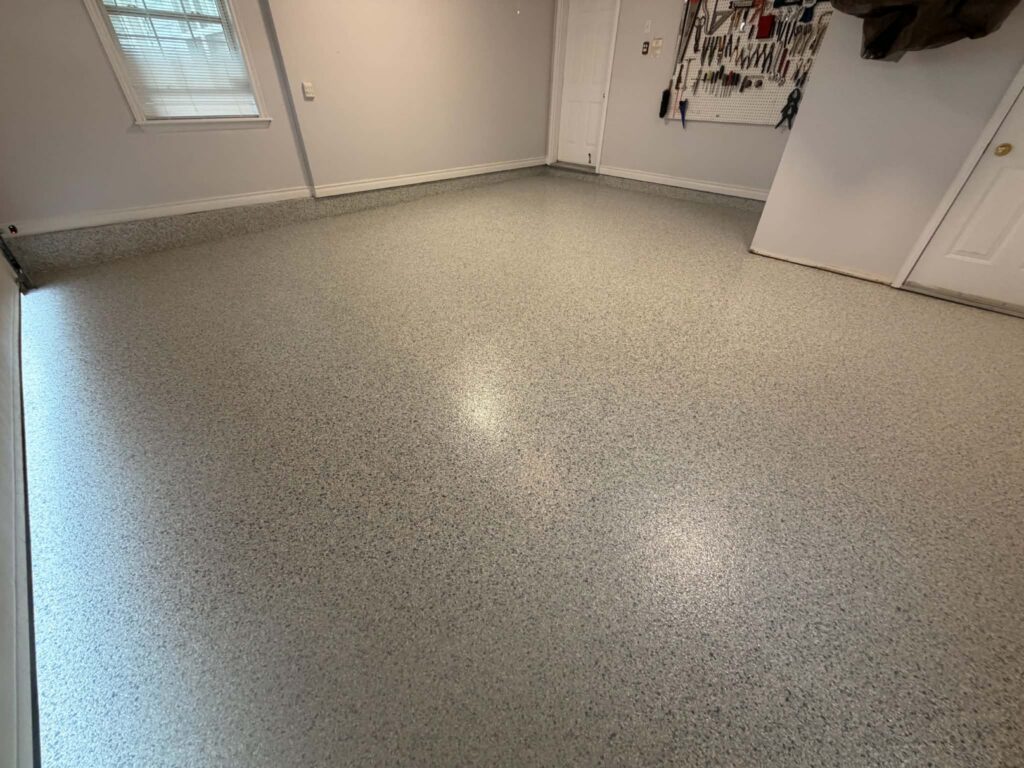
Tidal Wave in a home garage
Tidal Wave blends clean whites and river greys with soft blue tones. In a garage with pale walls it reads bright and modern rather than industrial, and it lifts a space that usually only has one window and an overhead light.
It earns its place practically too. The multi-tone flake hides road grit, tire marks and dust in a way a solid colour cannot, the broadcast texture gives grip when you walk in on a wet boot, and the thickness means it takes a dropped tool without chipping. We used the same blend recently on a very different job — a 130-year-old church basement in Lochaber — for exactly the same reason: it makes a dim room feel bigger.
Weighing colours? Start with flake vs solid colour garage floors.
Living with it through a Dartmouth winter
This is the part that matters in HRM. Between November and April your garage floor takes road salt, brine and slush off the car every single day. On bare concrete that mixture soaks in, freezes, expands and starts breaking the slab apart from the inside — which is how you end up with a pitted, spalling floor.
A sealed polyurea floor is non-porous, so the salt sits on top and mops off. Maintenance is genuinely a broom, plus warm water and a neutral cleaner when the winter grime builds up. No waxing, no resealing. More on the climate side in how floor coatings handle Nova Scotia’s freeze-thaw cycles.
Frequently asked questions
How long does a 400 sq ft garage floor coating take?
One day. Grinding runs through the morning, repairs and the base coat and flake broadcast follow in the early afternoon, and the clear topcoat goes down last. You can walk on it that evening and park on it within 24 hours.
Do I have to empty my garage first?
Yes, completely. We grind and coat wall-to-wall, so everything needs to be off the floor and away from the walls — including shelving, tires and appliances. Anything left in place becomes an uncoated patch in the finished floor.
Is the grinding dusty?
We run dust extraction at the tool, so the concrete dust is captured at source rather than drifting through the garage and into the house. It is noisy for a few hours, but it is not messy.
How much does a two-car garage floor coating cost in Nova Scotia?
It depends on the condition of the concrete more than the square footage. Cracking, spalling, a previous failed coating or a slab with high moisture all add preparation. Every quote we issue includes the prep and repair the slab needs, so the number you are given is the number you pay — see our Nova Scotia garage floor coating price guide for ranges by size.
Will road salt damage the coating?
No. A polyurea system is non-porous and chemically resistant, so salt and brine sit on the surface and wash off instead of soaking into the concrete. That protection is most of the reason to coat a garage floor in this climate.
How long will the floor last?
Properly prepared and installed, 15 to 20 years in a residential garage. This floor carries a 20-year warranty, which is only possible because of the grinding and preparation that happen before any colour goes down.
Book your garage floor coating in Dartmouth
One day, one crew, and a floor that handles everything a Nova Scotia winter drags in. Request a free quote and we will measure, assess your concrete and give you a clear, all-in price. Serving Dartmouth, Halifax, Bedford, Sackville and all of Nova Scotia — call (902) 986-6900.