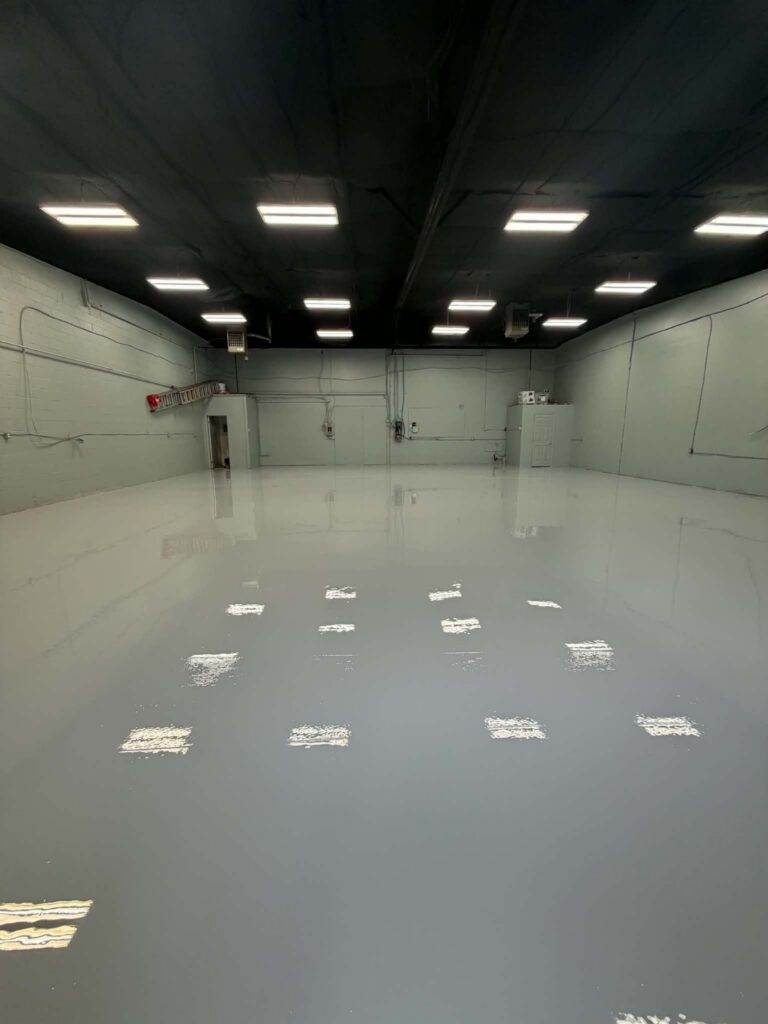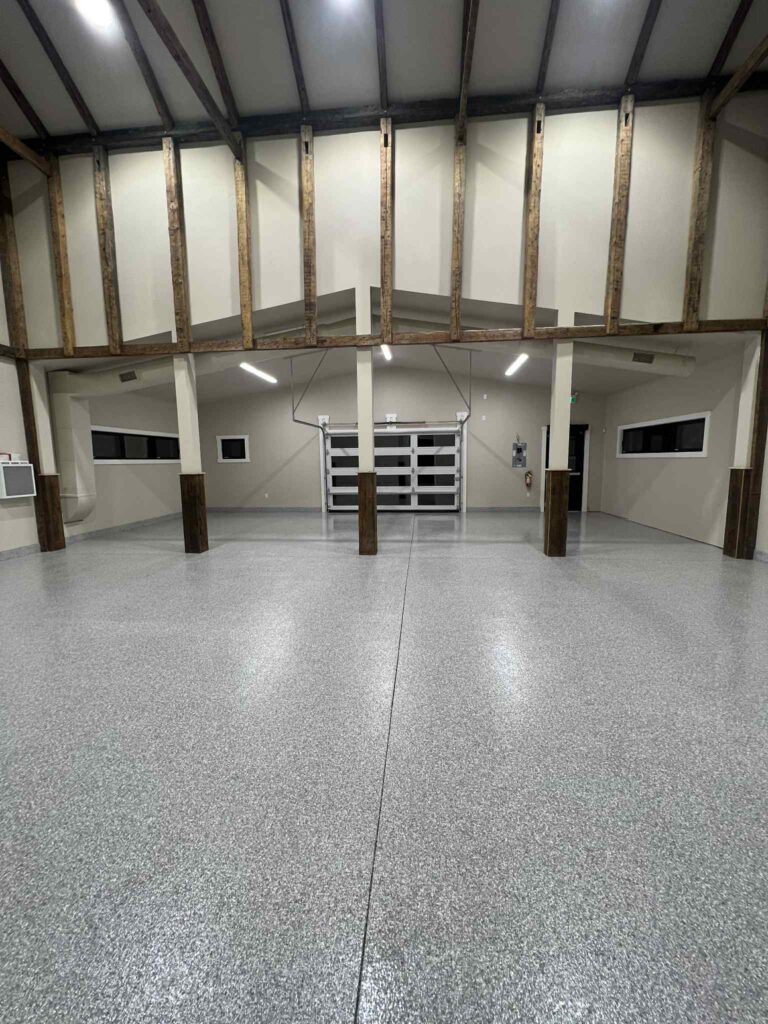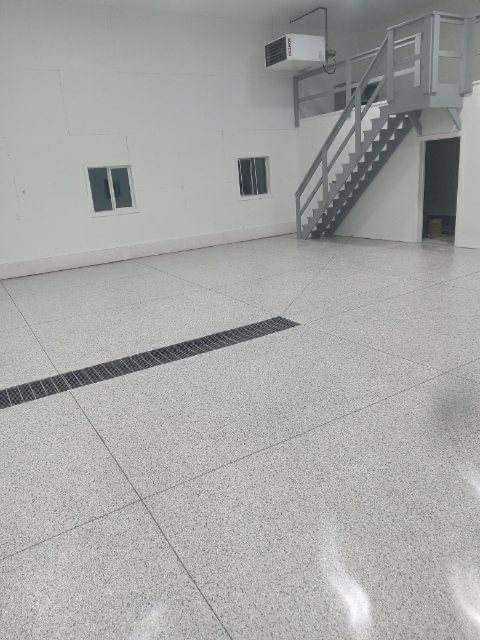
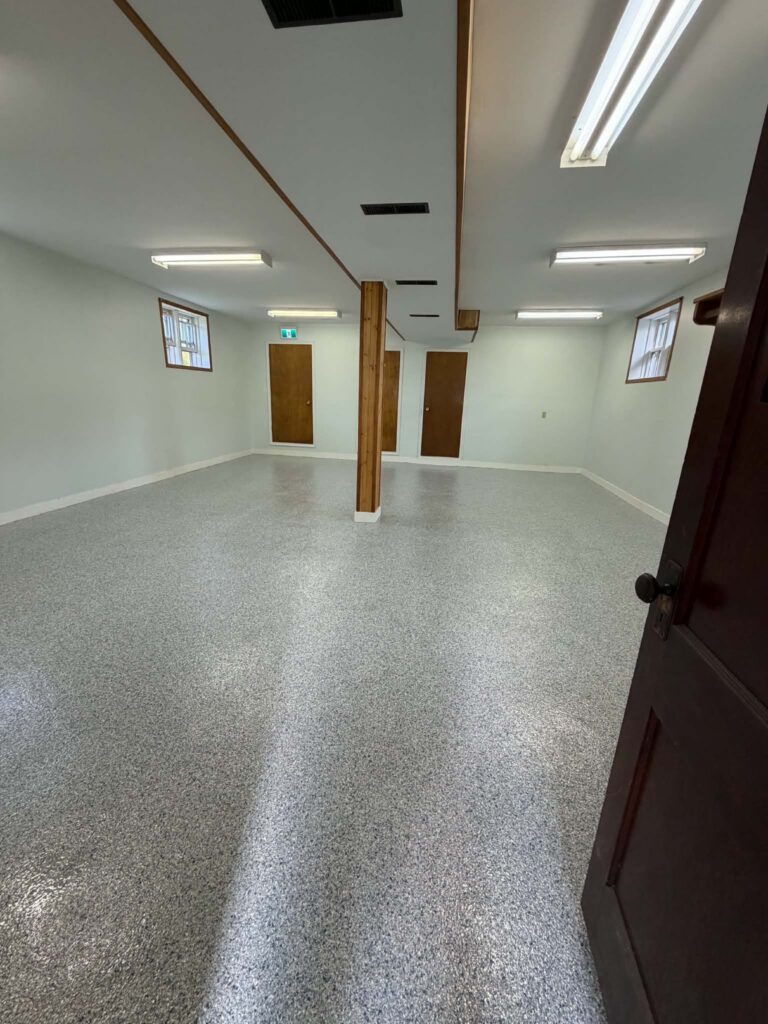
A 130-year-old church basement is not an easy floor to coat, and it is not a floor you can afford to get wrong. This one in Lochaber, Antigonish County, is 570 sq ft of hall that the congregation actually uses — suppers, meetings, receptions, storage. We finished it in a polyurea coating with Tidal Wave flakes, and the result is a bright, warm, easy-clean room that no longer looks like a basement.
Project snapshot: 570 sq ft church basement floor, Lochaber NS
| Detail | Spec |
|---|---|
| Building | 130-year-old church, Lochaber, Antigonish County, NS |
| Area | 570 sq ft basement hall |
| System | Polyurea base coat, full flake broadcast, clear topcoat |
| Flake colour | Tidal Wave — clean whites, river greys and soft blue tones |
| Finish | Light, bright, textured and slip-resistant underfoot |
| Use | Community hall — events, gatherings, foot traffic, tables and chairs |
| Warranty | 20 years |
What makes 130-year-old concrete different
Coating a century-old basement floor is a different job from coating a new slab, and anyone who quotes it as if it were the same has not looked closely enough. On a building this age you are usually dealing with some combination of:
- No vapour barrier. Slabs poured before modern practice sit directly on soil or fill. Ground moisture moves up through the concrete continuously — and moisture is what lifts a coating off an old floor.
- A soft, dusty or worn surface. Decades of wear leave a weak upper layer that has to be ground off to reach sound concrete.
- Old paint, sealers and adhesive. Church basements have usually been painted at least once. All of it has to come off mechanically.
- An uneven, hand-finished slab. Old floors were not laser-screeded. They dip, they hump, and they have patches from a century of repairs.
- Cracks that have already moved. These need treating, not covering.
This is exactly why we test slab moisture before quoting a basement rather than after. If the readings call for it, a moisture-control primer goes down first. Our guide to moisture-proofing basement floor coatings in Nova Scotia explains what that involves and why skipping it is the most expensive shortcut in the trade.
Why polyurea for a church basement
Three reasons, and only one of them is durability.
- It cures fast. A church hall is not a spare room. There are services, funerals, meetings and suppers on the calendar, and a floor system that needs a week of cure time means a week the building cannot be used. Polyurea lets us grind, coat, broadcast and topcoat in a short window and hand the room back quickly.
- It tolerates a cool basement. Polyurea and polyaspartic products cure across a far wider temperature range than epoxy, which matters in an unheated or barely heated basement in Nova Scotia. Epoxy in a cold basement often simply will not cure properly.
- It handles the real wear. Stacking chairs, folding tables, wet boots in March, spills at a supper. A polyurea system with a clear topcoat shrugs all of that off and mops clean.
If you want the technical comparison, we set it out in epoxy vs polyaspartic explained. The short version: polyurea is the flexible, fast-curing, chemically resistant family, and epoxy is the rigid, slow, temperature-fussy one.
Why Tidal Wave was the right colour
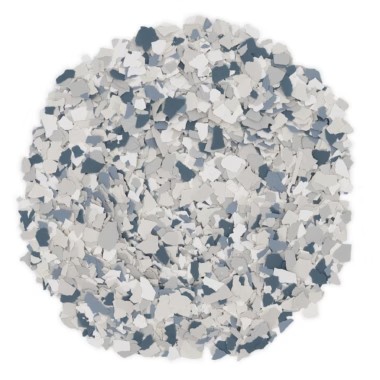
Tidal Wave is a crisp blend of clean whites and river greys lifted with two blues — Stormy Blue and Moody Blue. Torginol describes it as establishing a calm, airy atmosphere with a tranquil visual flow across a large space, and in a church basement that is not marketing language, it is the actual problem being solved.
Basements are dark. This one has small windows and fluorescent strips, and the old floor absorbed what light there was. A light, high-value flake floor reflects it back up into the room. Compare the two photos: the space reads as a hall now, not a cellar.
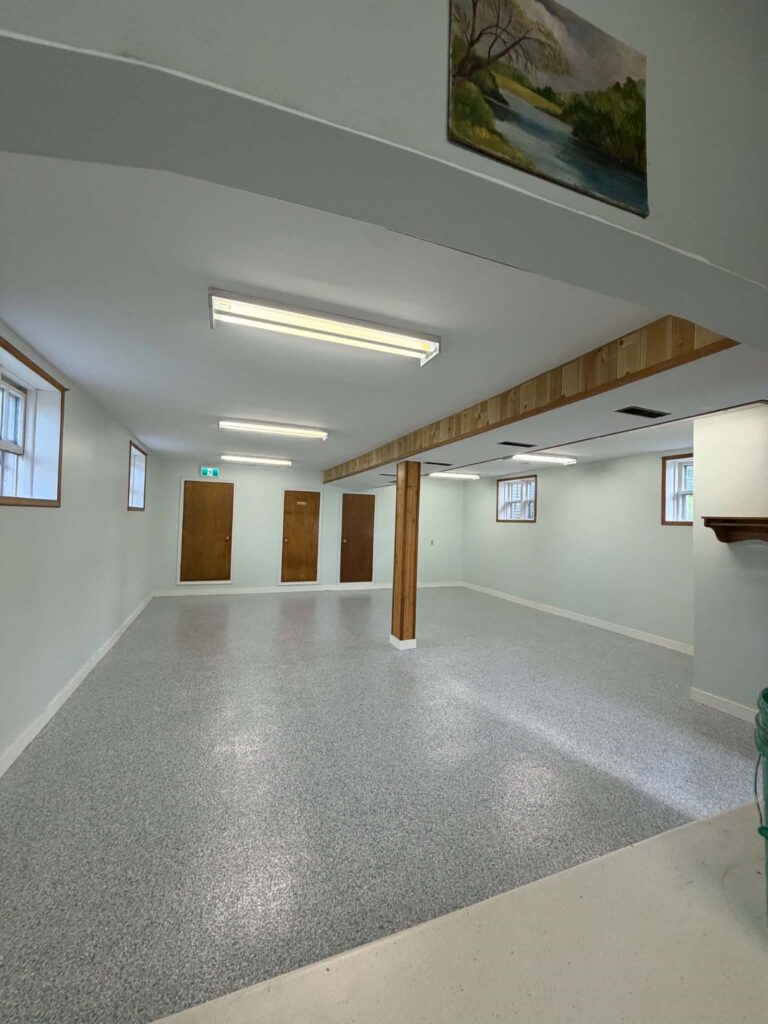
The flake does practical work too. It gives the surface texture, which means grip — a real consideration in a building where the congregation includes people who are not steady on a polished floor. It hides the scuffs and grit that come with community use. And because it is broadcast to refusal, it builds genuine thickness rather than sitting on the slab as a thin painted film. For institutional spaces where slip resistance is a formal requirement, an anti-slip aggregate can be added to the topcoat — see our guide to anti-slip commercial floor coatings and compliance.
Churches, halls and heritage buildings
Community buildings across Nova Scotia are sitting on floors like this one: old, cold, dusty concrete in rooms that get constant use and almost no capital budget. Coating is usually the sensible answer. It costs a fraction of breaking out and re-pouring a slab, it takes days rather than weeks, it seals the concrete against the moisture that is slowly destroying it, and it leaves a surface a volunteer can clean with a mop.
We do the same work for community halls, legion halls, church kitchens, daycares, clubhouses and heritage properties. If you are weighing the alternative, read resurfacing vs replacing concrete in Nova Scotia before you budget for a tear-out.
Frequently asked questions
Can you coat a 100-year-old basement floor?
Yes. Age itself is not the obstacle — moisture and surface condition are. Old slabs usually have no vapour barrier beneath them, so we test slab moisture first and use a moisture-control primer where the readings call for it, then diamond grind back to sound concrete before coating.
Will a coating stop my basement floor from being damp?
A correctly specified system with a moisture-control primer stops vapour coming up through the slab, which is what causes a damp, dusty, musty basement floor. It is not a fix for active water ingress through walls or a failed drain — those need solving first, and we will tell you if that is what we find.
How long does a church or community hall floor take?
A 570 sq ft hall is typically a one to two day job depending on the condition of the slab and whether a moisture primer is needed. Polyurea cures fast enough that the room is usually back in service within about 24 hours of the final coat.
What is Tidal Wave flake?
Tidal Wave is a decorative flake blend of clean whites, river greys and soft blue tones. Broadcast into the base coat and sealed under a clear topcoat, it produces a light, airy, granite-like finish that brightens dark rooms, hides dirt and adds slip-resistant texture.
Is a flake floor slippery?
No. The broadcast flake creates a lightly textured surface under the clear coat, which gives considerably more grip than smooth sealed concrete or tile. Where a space needs a higher formal slip rating, we broadcast an anti-slip aggregate into the topcoat.
Do you work with churches and non-profits?
Yes. We install commercial and institutional floor coatings across Nova Scotia, and we schedule around the building’s calendar so a hall is out of use for the shortest possible time.
Book a floor for your hall or heritage building
If your church basement, community hall or heritage building is running on tired, dusty concrete, it can almost certainly be saved. Request a free quote and we will test the slab, tell you honestly what it needs and price it with the preparation included. Serving Antigonish County and all of Nova Scotia — call (902) 986-6900.
Working on a project nearby? See our 700 sq ft polyurea garage floor in Antigonish.