Burnside is the largest industrial park north of Boston and east of Montreal — close to 2,000 businesses and roughly 30,000 people working in it every day. Almost all of them are standing on bare, sealed or failing concrete. We just finished a 3,000 sq ft commercial epoxy floor in Burnside Industrial Park for Recon Express, a Dartmouth auto body and reconditioning shop, using a solid grey epoxy build coat under a urethane topcoat. Here is what the job involved and why that system is the right call for a working shop floor.
Project snapshot: 3,000 sq ft commercial epoxy floor, Burnside
| Detail | Spec |
|---|---|
| Client | Recon Express — auto body and reconditioning |
| Location | Burnside Industrial Park, Dartmouth, Nova Scotia |
| Area | 3,000 sq ft shop floor |
| System | 100% solids epoxy build coat with a urethane topcoat |
| Colour | Solid grey, high gloss |
| Existing floor | Bare concrete with oil staining, adhesive and tar residue, control joints and hairline cracking |
| Prep | Diamond grinding, joint and crack treatment, degreasing, moisture check |
| Traffic rating | Vehicles, floor jacks, creepers, rolling tool boxes, foot traffic |
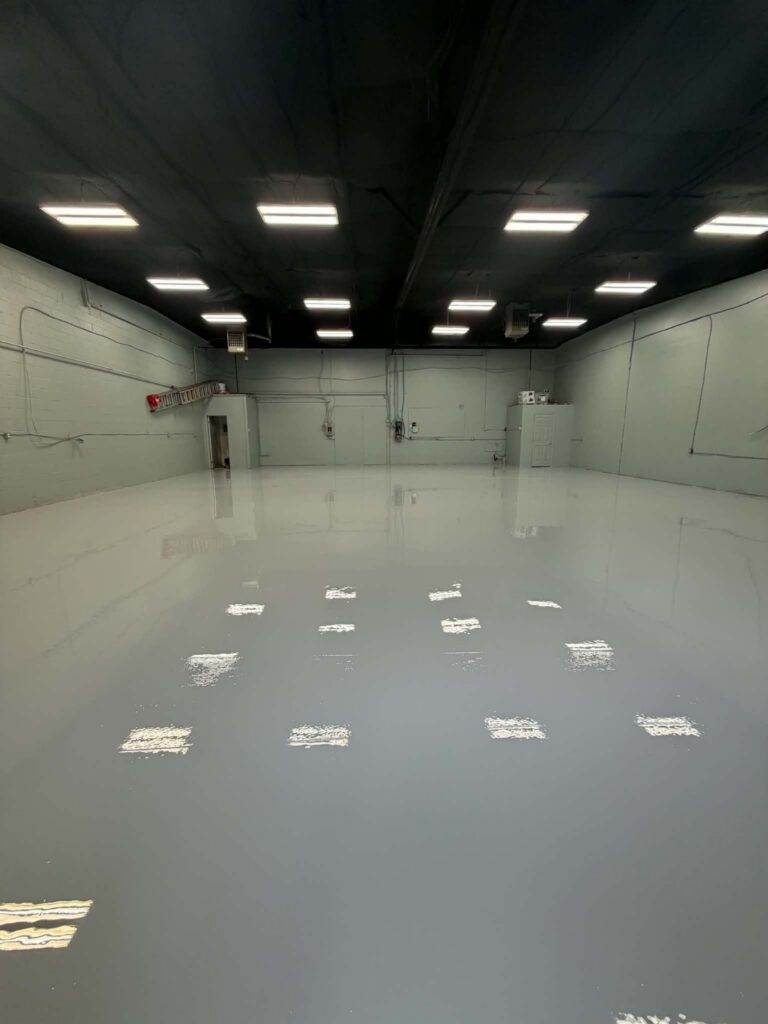
Why solid grey instead of a flake floor?
Decorative flake is the right answer in a residential garage. In a working body shop it is not. Recon Express went solid grey for three practical reasons:
- You can see what you drop. A clean solid colour makes a dropped clip, bolt or trim fastener findable in seconds. A busy flake pattern swallows small parts.
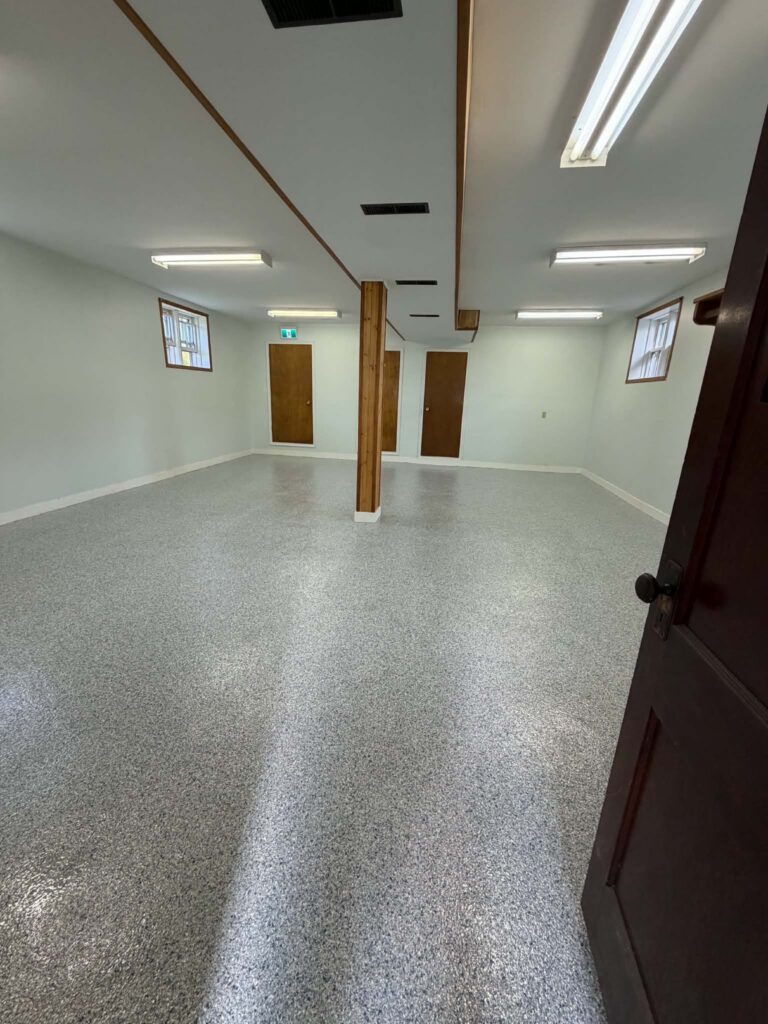
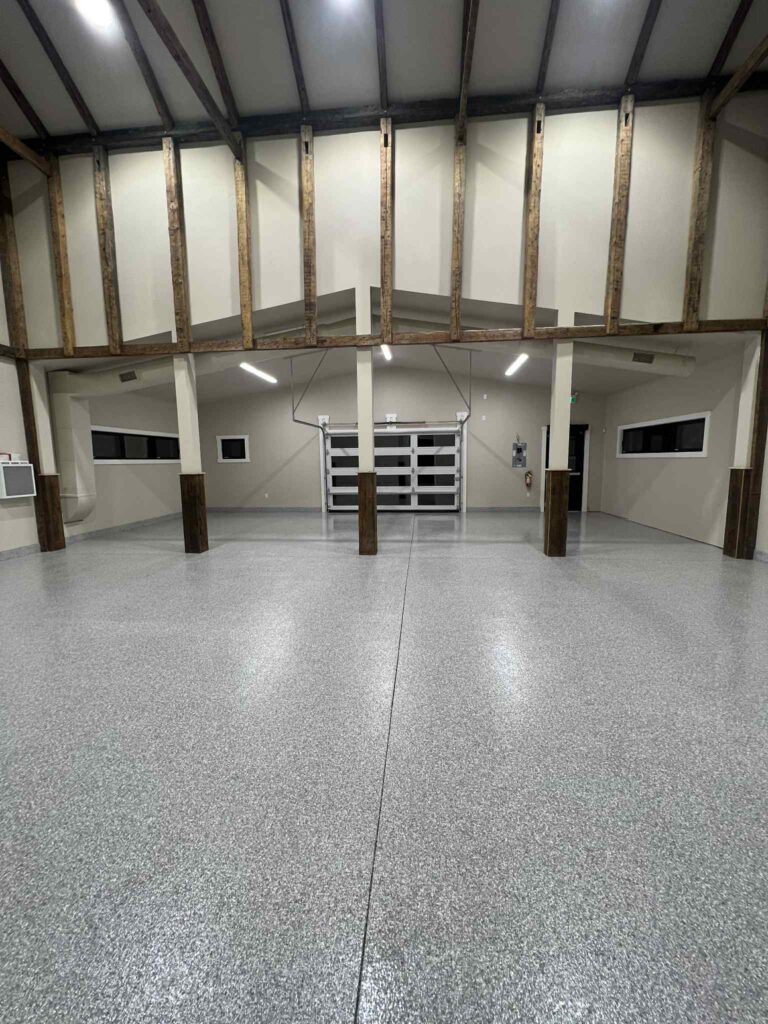
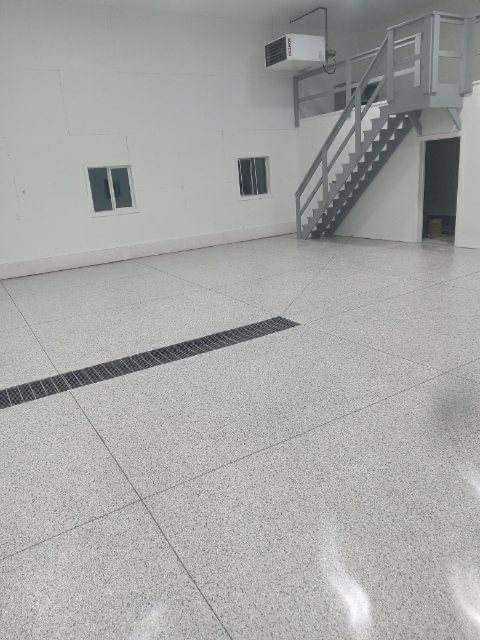
- Light. A high-gloss grey coating reflects the overhead fixtures back into the room. Compare the before and after photos — the same lights, dramatically more usable light at working height. That matters for colour matching and panel inspection.
- Cleanability. A smooth, non-porous surface squeegees and auto-scrubs clean. Sanding dust, body filler, brake fluid and coolant wipe off instead of soaking in.
If slip resistance is a concern for your operation, an anti-slip aggregate can be broadcast into the topcoat without changing the look. We cover that in detail in our guide to anti-slip commercial floor coatings and compliance for NS businesses.
What the urethane topcoat actually does
This is the part most quotes gloss over. Epoxy alone is a strong, thick, high-build coating — but it is not the best wearing surface. Adding a urethane topcoat over the epoxy gives you a genuinely commercial-grade floor:
- Abrasion resistance. Urethane is significantly harder-wearing than epoxy at the surface. Grit tracked in on tires and boots scuffs the topcoat, not the colour coat.
- Chemical resistance. Brake fluid, solvents, degreasers, battery acid and hydraulic oil sit on the surface instead of staining or softening the coating.
- Gloss and colour retention. Epoxy ambers and dulls under UV. A urethane topcoat holds its gloss and its grey, which matters in a bay with open doors and skylights.
- Easier recoating. When the topcoat eventually wears in the heaviest traffic lane, it can be scuffed and recoated without stripping the whole system.
Think of the epoxy as the body and the urethane as the armour. It is the same logic we apply on every job in our industrial epoxy flooring work.
The concrete we started with
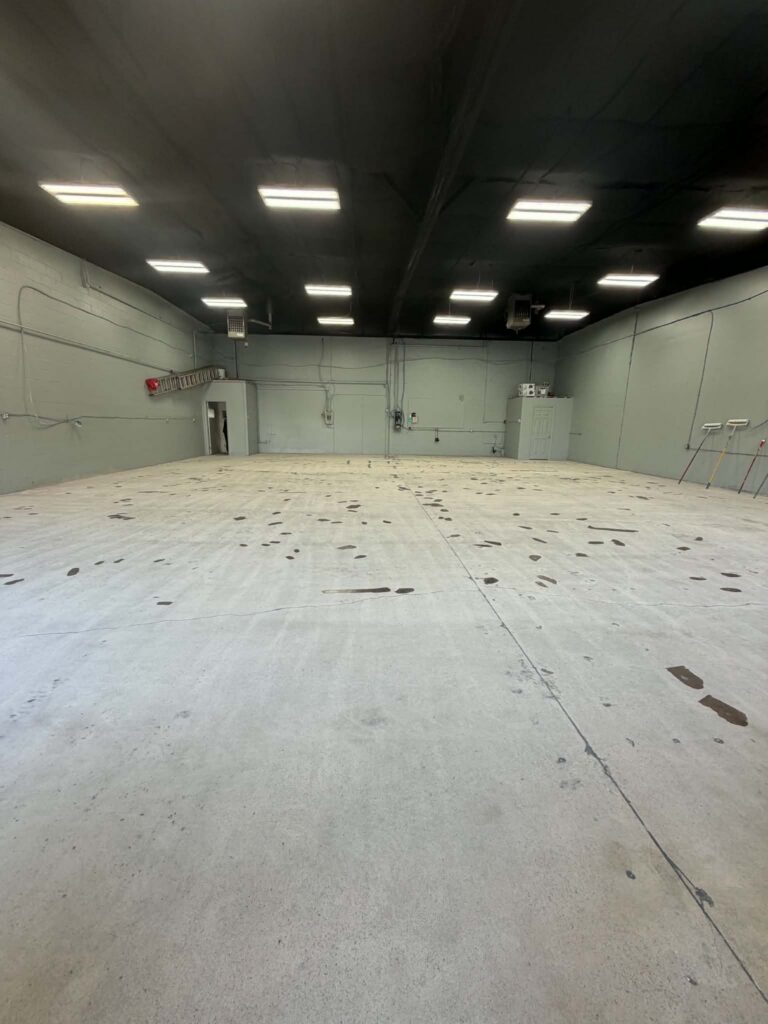
The before photo tells the real story. This slab had years of shop life in it: oil and fluid staining, dark adhesive and tar residue across the middle of the floor, a full-length control joint, hairline cracking and the usual dusting surface you get on untreated industrial concrete.
None of that gets coated over. Every contaminant has to come off mechanically, because a coating is only ever as good as its bond to the slab.
How we coated 3,000 sq ft without shutting the shop down
1. Diamond grinding the full slab
We ground the entire 3,000 sq ft to remove residue, staining and the weak surface layer, and to open a proper mechanical profile for the epoxy. Dust is collected at the tool with HEPA extraction, so we are not filling a body shop with silica.
2. Joints, cracks and moisture
Control joints and cracks were cut, cleaned and filled with a semi-rigid joint filler, then ground flush. We also test slab moisture before anything goes down — a high-vapour slab needs a moisture-control primer or the coating will blister, and on a floor this size that is an expensive lesson.
3. Solid grey epoxy build coat
The pigmented 100% solids epoxy was rolled and back-rolled in a continuous wet edge across the full floor. On an open 3,000 sq ft bay this is a timed job: the whole area has to be coated before the leading edge sets, or you get lap lines.
4. Urethane topcoat
Once the epoxy cured, the urethane clear went down as the wearing surface, giving the floor its gloss, its chemical resistance and its scuff resistance.
5. Staged return to service
Commercial work is planned around the client’s schedule, not ours. We sequence grinding and coating so the shop loses the minimum number of working days, and we walk the finished floor with the owner before we leave.
What does a 3,000 sq ft commercial epoxy floor cost in Nova Scotia?
Commercial epoxy with a urethane topcoat generally runs $5 to $10 per square foot in Nova Scotia, putting a 3,000 sq ft shop in roughly the $15,000 to $30,000 range. Larger floors bring the per-square-foot rate down; heavy prep pushes it up. The variables that actually move a commercial quote are:
- Slab condition — contamination, spalling, joint count and any previous failed coating.
- Moisture — whether a vapour-control primer is required.
- System build — coating thickness, anti-slip aggregate, line marking or coloured zoning.
- Access and scheduling — after-hours or weekend work to keep you operating.
Facility managers pricing a project should read our buyer’s guide to commercial epoxy flooring in Halifax before comparing quotes — the cheapest number on the page is almost always the one with the least preparation in it.
Why Burnside businesses coat their floors
Burnside and City of Lakes cover roughly 3,400 acres and hold the largest concentration of truck transportation in Atlantic Canada. That means forklifts, pallet jacks, floor jacks, road salt dragged in all winter and constant chemical exposure — on slabs that were often poured decades ago and never sealed.
A coated floor protects the asset underneath, cuts cleaning time, brightens the space and makes an operation look like it is run properly when a customer or an insurer walks through the door. For shops weighing the alternative, our comparison of epoxy vs polished concrete for commercial spaces is a good starting point.
Frequently asked questions
Why add a urethane topcoat over epoxy?
Epoxy provides thickness, adhesion and colour, but urethane is harder wearing at the surface, more chemically resistant and holds its gloss and colour under UV. The combination gives you a floor that resists abrasion and solvents far better than epoxy alone, and the topcoat can be recoated later without stripping the whole system.
How long does a 3,000 sq ft commercial epoxy floor take to install?
Typically two to four working days depending on slab condition, moisture and how many coats the system calls for. Grinding and repairs take the first day, the epoxy build coat follows, and the urethane topcoat goes down last. Light foot traffic usually resumes within 24 hours of the final coat and full service within 72 hours.
Is epoxy flooring good for an auto body shop?
Yes, provided it is topcoated. An epoxy and urethane system resists brake fluid, solvents, oil and battery acid, handles floor jacks and vehicle traffic, and cleans up quickly after sanding and body filler work. Bare concrete absorbs all of it permanently.
Can you coat a floor without closing my business?
In most cases, yes. We stage large floors in sections and schedule grinding and coating around your operating hours, including evenings and weekends, so you keep working while the job progresses.
Will the coating stick to an oil-stained shop floor?
Only if the contamination is removed first. We degrease, then diamond grind the full slab to take off staining, residue and the weak surface layer. Coatings applied over contaminated or acid-etched concrete are the number one cause of failures we get called in to fix.
Do you do commercial floors outside Dartmouth?
Yes. We install commercial floor coatings throughout Nova Scotia — Halifax, Bedford, Truro, New Glasgow, Sydney, Port Hawkesbury, Amherst, Bridgewater and the Annapolis Valley.
Book your commercial floor coating in Burnside
If your shop, warehouse or service bay is running on bare or failing concrete, we will come out, assess the slab and give you a clear scope and price with preparation included. Request a free commercial quote or call (902) 986-6900 — serving Burnside Industrial Park, Dartmouth, Halifax and all of Nova Scotia.